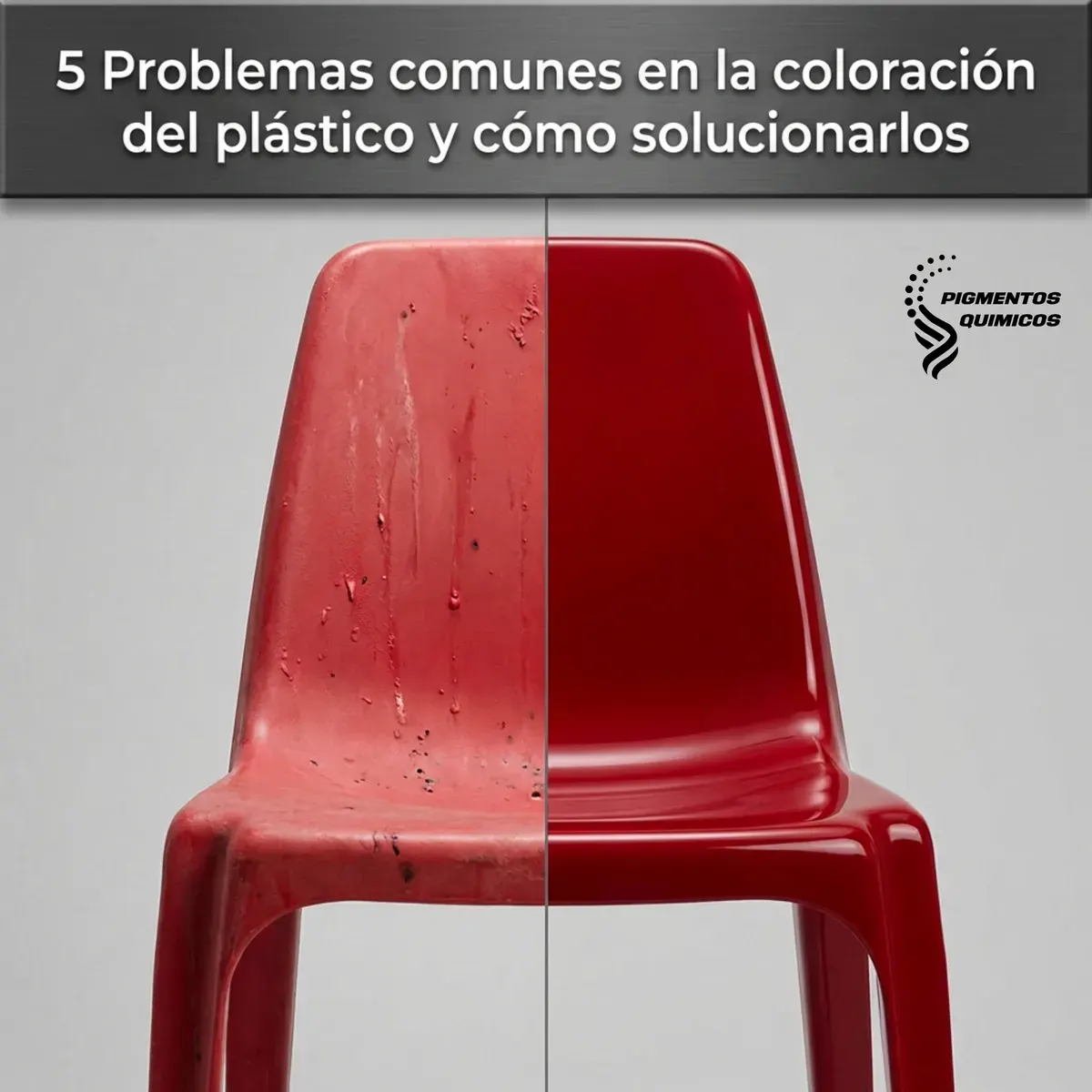
5 Common Problems in Plastic Coloring and How to Solve Them
Poor dispersion, thermal degradation, and migration: a technical guide to avoiding waste.
5 Common Problems in Plastic Coloring and How to Solve Them
Coloring plastic parts is a critical step in the industrial production chain. A color defect not only compromises the aesthetics of the final product but can lead to batch rejections, costly reprocessing, and loss of client trust. In a market where visual consistency is synonymous with quality, identifying and resolving coloring problems in time is essential for maintaining competitiveness.
Below are the five most frequent problems faced by plastics processors in coloring, along with the most effective technical solutions for each case.
1. Poor Pigment Dispersion
What is it and how does it manifest?
Poor dispersion occurs when the pigment is not distributed homogeneously within the polymer matrix. The result is parts with color streaks, concentrated pigment spots, visible clumps, or uneven surface shading. This defect reduces the tinting strength of the colorant and generates variations that cause different appearances within the same batch.
Main causes
Among the most common causes are the use of pigments with inadequate particle size, masterbatch particle size that differs significantly from the base resin, insufficient process temperatures to achieve complete fusion, and excessively low back pressure on the injection or extrusion machine.
Recommended solutions
It is recommended to select pigments with optimal particle size and verify that the concentrate particle size is similar to that of the application polymer. Adjusting the temperature in the mixing zone near the discharge port and applying adequate back pressure on the plasticizing screw also contributes to improving homogenization. In injection processes, verify that the plasticization cycle is long enough to ensure uniform mixing.
2. Thermal Degradation of the Pigment
What is it and how does it manifest?
Thermal degradation occurs when the pigments used cannot withstand the temperatures of the processing method. The resulting parts show streaks of more intense or different color than expected, shade changes, and in severe cases, dark spots resulting from chemical decomposition of the colorant.
Main causes
This problem originates when the thermal resistance of the pigment is lower than the processing temperature of the resin. It can also occur when the masterbatch remains too long in the machine barrel at high temperature, or when engineering resins requiring elevated temperatures are processed with pigments designed for lower-demand polymers.
Recommended solutions
The primary solution is to use pigments whose thermal resistance exceeds the maximum temperature of the processing method. It is essential to request from the masterbatch supplier the technical data sheet specifying the pigment's working temperature range. Additionally, the equipment temperature must be precisely controlled and material residence times in the barrel minimized.
3. Color Migration
What is it and how does it manifest?
Migration occurs when colorant molecules diffuse from the interior of the plastic part to its surface and, in some cases, to the substrate in contact with it. It is observed as surface stains, color transfer to other materials, or progressive loss of chromatic intensity. This problem is particularly critical in food contact applications and in multilayer packaging.
Main causes
Migration usually occurs when low-molecular-weight organic colorants are used that have greater mobility within the polymer matrix. Excessive colorant concentration relative to the part thickness, lack of chemical compatibility between the colorant and the resin, and prolonged exposure to high temperatures during product use also contribute.
Recommended solutions
It is recommended to replace soluble colorants (dyes) with insoluble high-molecular-weight pigments when the application allows. Adjusting the colorant concentration to the specific thickness of the part and verifying the chemical compatibility between the coloring system and the base resin are essential measures. For food contact applications, it is mandatory to use certified pigments complying with current regulations.
4. Color Inconsistency Between Batches
What is it and how does it manifest?
Batch-to-batch color inconsistency refers to chromatic variation occurring between different production runs of the same product. Although each individual part may look correct in isolation, when batches produced at different times are compared, differences in hue, saturation, or brightness are detected that are unacceptable to the end client.
Main causes
Causes include variations in masterbatch dosing (inaccurate or random measurement), changes in resin brand or lot without adjusting the color formulation, differences in process parameters between shifts or machines, and inadequate storage conditions for the color concentrate that can alter its performance.
Recommended solutions
Implementation of high-precision gravimetric dosing systems is one of the most effective measures. The base resin must be standardized and the masterbatch supplier notified of any material change. Using spectrophotometers or colorimeters for quality control of each batch allows deviations to be detected before they reach the client. Establishing documented process parameters verified by shift and machine closes the control loop.
5. Discoloration from UV Exposure and Environmental Factors
What is it and how does it manifest?
Discoloration occurs when plastic parts lose intensity or change shade after prolonged exposure to ultraviolet radiation, ambient heat, or chemical agents. Outdoor products such as urban furniture, pipes, window profiles, and automotive components are most vulnerable to this phenomenon.
Main causes
The main cause is the selection of pigments with low light fastness. The absence of UV stabilizer additives in the formulation also contributes significantly. Other factors include exposure to oxygen (which promotes polymer oxidation), contact with acids, alkalis, or solvents, and the use of resins that by their nature are more susceptible to photodegradation.
Recommended solutions
For outdoor applications, pigments with high lightfastness and weatherfastness must be specified, consulting the lightfastness scales established in international standards. Incorporating masterbatch with UV stabilizers protects both the polymer and the pigment. The use of antioxidant masterbatch complements protection against degradation. It is advisable to conduct accelerated aging tests (weatherometer chamber) before validating a color formulation for outdoor use.
Conclusion: Coloring as a Competitive Advantage
Coloring problems in the plastics industry are not inevitable. With appropriate technical selection of pigments and masterbatches, rigorous control of process parameters, implementation of color measurement instruments, and fluid communication between the processor and their concentrate supplier, it is possible to achieve consistent, reliable chromatic quality in every production batch.
Investing in the prevention and resolution of these five common problems not only reduces waste and reprocessing, but strengthens brand image and client trust in the final product. In an increasingly competitive market, excellence in coloring becomes a high-impact strategic differentiator.
Frequently Asked Questions (FAQ)
What is the most frequent problem in plastic coloring?
Poor pigment dispersion is considered the most common problem. It manifests as color streaks, clumps, or uneven shading in the final part and is resolved by adjusting pigment particle size and process parameters.
How to avoid thermal degradation of pigments in plastics?
It is necessary to select pigments whose thermal resistance exceeds the maximum processing temperature. Controlling material residence time in the barrel and requesting technical data sheets from the masterbatch supplier are key preventive actions.
What causes color migration in plastic parts?
Migration is primarily due to the use of low-molecular-weight colorants that diffuse toward the polymer surface. It is resolved by using high-molecular-weight insoluble pigments and adjusting the concentration to the part thickness.
How is color consistency between production batches guaranteed?
Consistency is achieved through high-precision gravimetric dosing, standardization of the base resin, instrumental color control with spectrophotometers, and rigorous documentation of process parameters by shift and machine.
How to protect plastics from UV discoloration?
Pigments with high lightfastness must be used, UV stabilizers and antioxidants must be incorporated into the formulation, and validation through accelerated aging tests in a weatherometer chamber must be conducted before serial production.