Barrier and Preservation: Additives That Extend Shelf Life
How EVOH and oxygen scavengers reduce food waste and protect your products.
Barrier and Preservation: Additives That Extend Shelf Life
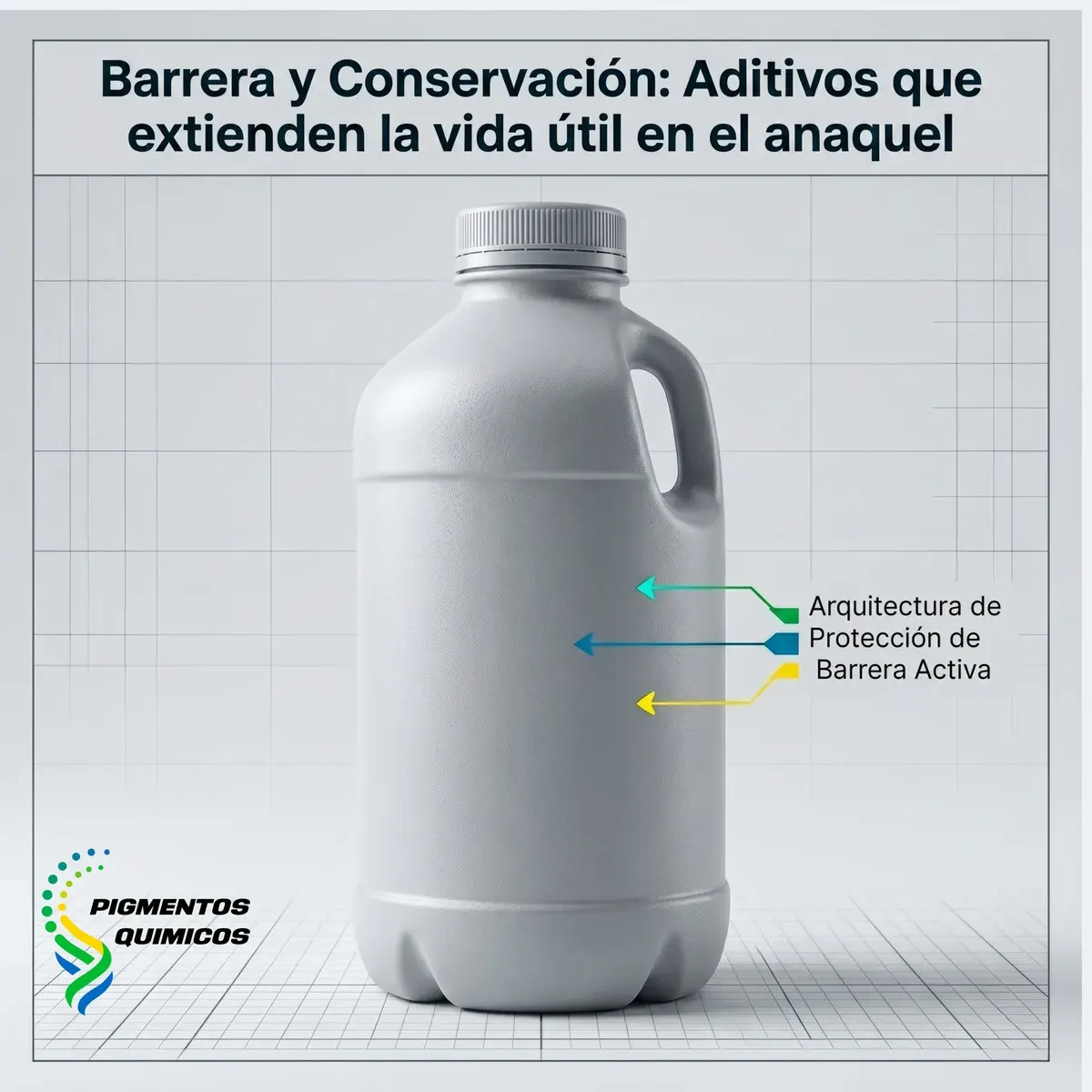
Barrier additives in plastic packaging — EVOH, oxygen scavengers, antioxidants, and inorganic coatings — reduce permeability to gases and moisture, inhibiting oxidation and microbial growth. The result is a shelf life up to three times longer without modifying the safety of the product.
Product loss due to deterioration before it reaches the end consumer represents one of the greatest challenges in the supply chain of the packaging industry. We have identified that between 14% and 17% of packaged foods are lost or wasted during collection, distribution, and storage — figures that are significantly reduced when advanced barrier solutions are incorporated into plastic packaging design.
In this article we analyze in detail how the main barrier additives work, what properties they bring to the packaging structure, and how our experience in the plastics industry allows us to formulate solutions that balance performance, recyclability, and regulatory compliance.
Why Oxygen and Moisture Are the Main Enemies of Shelf Life
Oxygen triggers oxidation reactions that degrade lipids, proteins, and nutrients; alters color, flavor, and texture; and accelerates aerobic microbial growth. Free radicals generated during these processes attack biomolecules, cause fat rancidity, and enzymatic browning. Moisture, in turn, can soften structures, dissolve pigments, and favor the proliferation of molds and yeasts.
We have confirmed in projects with multiple clients in the food industry that, in the absence of an effective oxygen barrier, conventional flexible packaging allows oxygen transmission rates (OTR) that compromise product stability within days. In contrast, structures designed with appropriate barrier additives reduce OTR to values below 0.1 cm³/m²·day·bar, considerably extending the commercial window of the product.
Main Types of Barrier Additives in the Plastics Industry
1. EVOH (Ethylene Vinyl Alcohol Copolymer)
EVOH is the reference material for high oxygen barrier in multilayer structures. Our experience indicates that an EVOH layer at 32 mol% vinyl alcohol can keep oxygen levels below 0.1% inside the package, extending, for example, the half-life of vitamin C up to 18 months in cosmetic and nutraceutical applications. The technical challenge of EVOH lies in its moisture sensitivity: when relative humidity exceeds 60%, its barrier properties degrade. The standard solution we apply is coextrusion in PP/EVOH/PP structures, where the polypropylene layers protect the EVOH core against water vapor penetration.
Recent innovations such as Winpak's REVOH technology incorporate micron-scale minerals into the outer PP layers to create an additional moisture barrier. Reported results show a 30 to 35% reduction in post-retort oxygen transmission, which translates into significantly extended shelf life in thermoformed packaging for sterilized foods.
2. Oxygen Scavengers
Oxygen scavengers represent the second line of defense, especially in active packaging. They function as reactive elements that actively absorb residual oxygen inside the sealed package, bringing internal concentration to undetectable levels. We have worked with systems based on reactive hydrocarbon polymers doped with transition metals (e.g., neodecanoate cobaltate), which are incorporated into masterbatch directly in polyethylene/polypropylene films.
A strategic advantage of active scavengers is that they allow complex EVOH coextrusions to be replaced with single-layer transparent, fully recyclable bottles or trays that maintain an oxygen loss rate of only milligrams per day. Non-metallic enzymatic systems (glucose oxidase, ascorbate) offer an alternative for products where a 'clean label' without metals is desired.
3. Antioxidants in the Polymer Matrix
Incorporating antioxidants directly into the polymer matrix inhibits degradation of the packaging material during processing and shelf life, while potentially releasing controlled amounts of active principles that protect the packaged product. Among the most widely used synthetic antioxidants are BHT (butylhydroxytoluene), BHA (butylhydroxyanisole), and TBHQ (tertiary butylhydroquinone). Recent research (2024–2025) has shown that curcumin/β-cyclodextrin complexes incorporated into alginate films reduce oxygen permeability by 38% and water vapor by 28%, without compromising the mechanical properties of the film.
The trend we have observed in the market points toward natural-origin antioxidants (polyphenols, flavonoids, rosemary extracts, chitosan) that respond to the demand for synthetic-free formulations compatible with increasingly strict food contact regulations.
4. Inorganic Coatings: SiOx and AlOx
Silicon oxide (SiOx) and aluminum oxide (AlOx) coatings vacuum-deposited on PP or PET substrates are an alternative to conventional multilayer systems, with the advantage of maintaining recyclability of the monomaterial when the coating thickness does not exceed 5% of the total package weight (CEFLEX criterion). Studies published in 2024 in the journal Coatings (MDPI) confirmed that PP/SiOx and OPP/AlOx films achieve OTR values below 0.1 cm³/m²·day·bar, comparable to conventional multilayer structures.
5. Multilayer and Monomaterial Structures with Barrier
The historical standard has been the multilayer structure (2 to 11 layers) combining materials with specific functions: outer structural layer, adhesives, barrier layer, and sealant. However, regulatory pressure — particularly the European Packaging and Packaging Waste Regulation (PPWR), in force from February 2024 with full application in August 2026 — is driving the development of monomaterials with integrated barrier additives that maintain protection performance and are compatible with existing mechanical recycling streams.
Our solution in this segment combines barrier masterbatch with polyolefin base resins, achieving PE or PP structures with medium-to-high barrier properties that comply with RecyClass guidelines and are accepted by major recycling facilities.
Key Metrics for Selecting the Right Barrier Additive
Global Market: Reference Figures
The global plastics market reached approximately 545 billion pounds in 2024, with a projection of 790 billion for 2031. The high-barrier plastic food packaging segment accounted for 70 of the 180 billion pounds of plastic packaging and generated approximately $60 billion in 2024, with an estimated compound annual growth rate of 4.7% through 2031. These figures confirm that investment in barrier technology is an economic imperative, not just a technical one.
Conclusion: Design the Right Barrier from the Start
We have learned, working with clients in multiple industrial segments, that the decision on the barrier system must be made at the packaging design stage — not as a subsequent correction. Integrating barrier additives — EVOH, scavengers, antioxidants, and inorganic coatings — from the masterbatch formulation allows optimization of the OTR target, guaranteeing recyclability and meeting current regulations, all at the lowest possible material cost.
If your company is evaluating barrier solutions to extend the shelf life of its products, we invite you to review our related articles on masterbatch formulation and sustainable multilayer structure design.
Frequently Asked Questions (FAQ)
What is EVOH and why is it the most widely used barrier additive in plastic packaging?
EVOH (ethylene vinyl alcohol copolymer) is the reference material for oxygen barrier in multilayer structures because it combines exceptional barrier properties, processability in coextrusion, and compatibility with polyolefins. Its main limitation is moisture sensitivity, which is managed by protecting it with polypropylene or polyethylene layers.
How much can shelf life be extended with barrier additives?
It depends on the product, substrate, and barrier system chosen. In processed foods, high oxygen barrier structures can triple shelf life compared to conventional packaging. For cosmetics with active vitamin C, EVOH has been shown to extend the half-life of the active ingredient up to 18 months.
Is packaging with barrier additives recyclable?
Yes, provided the design accounts for this from the start. SiOx/AlOx coatings and EVOH layers are compatible with polyolefin mechanical recycling if they do not exceed 5% of the total package weight, according to CEFLEX guidelines. Monomaterials with integrated barrier additives offer the greatest compatibility.
What is the difference between an oxygen scavenger and a passive barrier material?
A passive barrier material (such as EVOH) physically prevents oxygen from penetrating through the package wall. An oxygen scavenger is an active system that chemically reacts with residual oxygen inside the sealed package, consuming it. The combination of both offers the greatest protection.
What regulations apply to barrier additives in food contact applications?
In the European Union, Regulation EC 10/2011 on plastic materials in contact with food establishes the positive lists of authorized substances. In Mexico, the applicable NOMs issued by COFEPRIS apply. In the USA, 21 CFR of the FDA regulates indirect food contact substances. It is essential to verify the approval of each additive for the target market.
What is the trend for 2025–2030 in barrier additives?
The industry is moving toward recyclable monomaterials with integrated barriers, natural antioxidants (polyphenols, chitosan), metal-free scavenging systems for clean label, and barrier structures compatible with the post-consumer recycled content required by the European PPWR by 2030.