Is Your Masterbatch Safe for Food Contact? Key Verifications
EU 10/2011 and FDA regulations: what you need to know about the Declaration of Conformity and migration limits.
Is Your Masterbatch Safe for Food Contact? What Every Plastics Company Must Verify
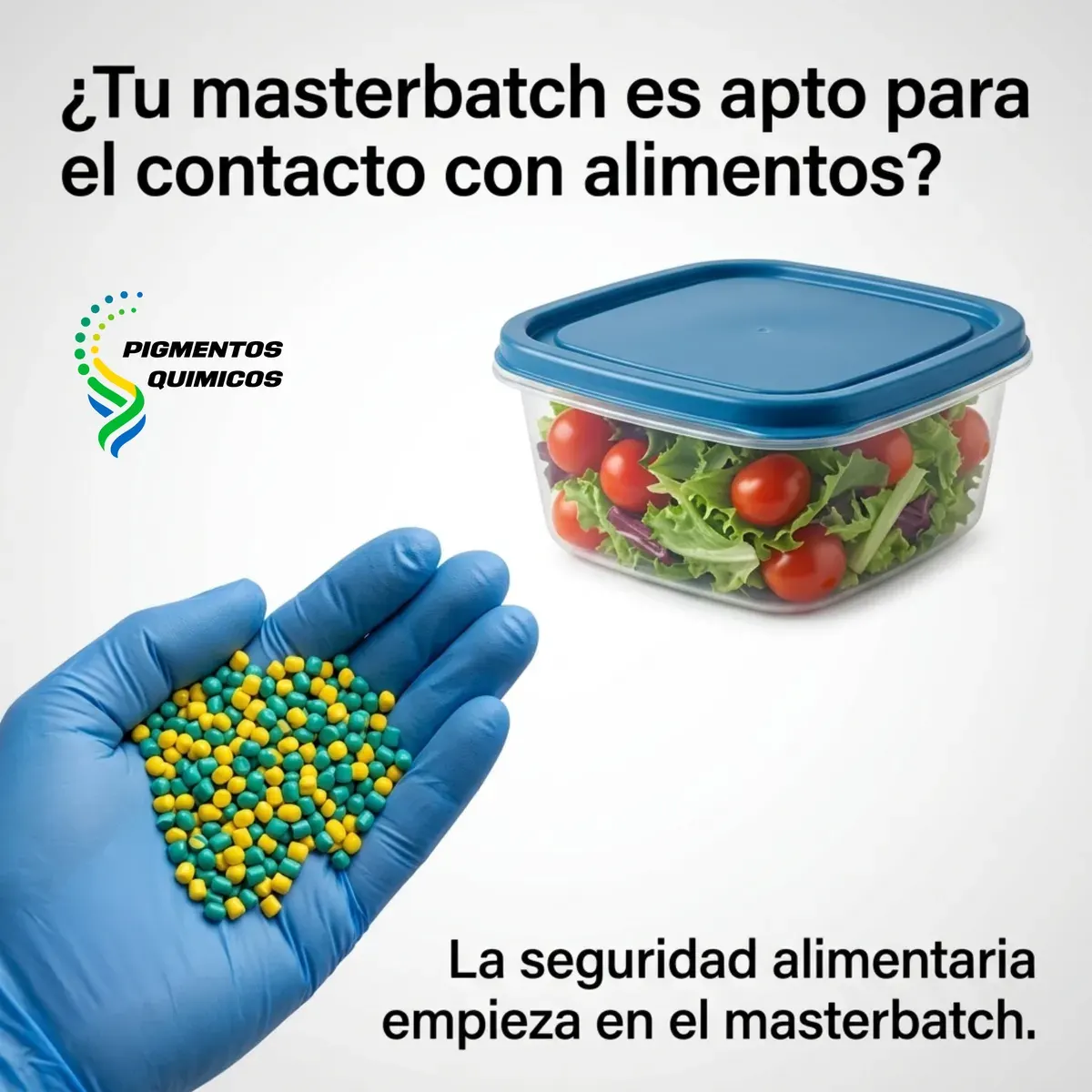
A masterbatch is suitable for food contact when its pigments, additives, and carrier resin are authorized under EU Regulation 10/2011, FDA 21 CFR, and carry a current Declaration of Conformity certifying safe migration limits.
Why regulatory compliance for your masterbatch is no longer optional
We have observed that one of the most frequent errors in the supply chain of plastic food packaging is assuming that any masterbatch can be used in direct food contact applications. This assumption can expose manufacturers to regulatory penalties, product market withdrawals, and most importantly, risks to the health of the end consumer.
In our technical experience, regulatory compliance in this area has evolved radically. The entry into force of Regulation (EU) 2025/351 in March 2025, which modifies and tightens Regulation (EU) 10/2011, has raised purity and traceability standards for all plastic materials in contact with food, including masterbatches and their components.
What regulations govern food-grade masterbatch?
We identify three key regulatory frameworks that directly impact manufacturers and plastics processors working with food contact applications:
1. Regulation (EU) 10/2011 and Regulation (EU) 2025/351 — European Framework
This regulation establishes the Union Positive List: only substances included in this list may be used in the manufacture of plastic materials in contact with food. This includes the pigments, additives, and carrier polymers that make up a masterbatch. The amendment introduced by Regulation 2025/351, in force from March 2025, introduces stricter requirements for genotoxicity assessment of substances, purity of recycled polymers, and reinforcement of Good Manufacturing Practices (GMP).
Additionally, Regulation (EC) 1935/2004 acts as a mandatory general framework for all food contact materials (FCM) in the EU, requiring that such materials not transfer their components to food in quantities that could represent a danger to human health.
One of the key tools of this system is migration testing: overall migration cannot exceed 10 mg/dm² of contact area, while specific migration of each substance has its own Specific Migration Limits (SML) defined in Annex I of the Regulation.
2. FDA 21 CFR — North American Market
In the United States, the Food and Drug Administration (FDA) regulates food contact materials through Title 21 of the Code of Federal Regulations (21 CFR), particularly Parts 174–186. Unlike the European system, the FDA bases its evaluation on material exposure (not just migration) and operates primarily through the Food Contact Notification (FCN) program and the GRAS (Generally Recognized As Safe) category.
For the pigments and additives of a masterbatch to comply with FDA regulation, they must be listed in 21 CFR, hold an approved FCN, or qualify for the Threshold of Regulation (TOR) exemption, which applies when the resulting exposure is less than 0.5 parts per billion (ppb).
3. ISO 22000 and FSSC 22000 — Food Safety Management in the Process
Beyond raw material regulatory compliance, we have identified that leading clients in the food value chain increasingly require their masterbatch suppliers to operate under certified food safety management systems such as ISO 22000 or FSSC 22000. These frameworks require the implementation of HACCP (Hazard Analysis and Critical Control Points) analysis, supplier verification programs, and documentary traceability control.
Which masterbatch components must be authorized?
In our technical assessment, the three critical components of any food contact masterbatch are:
The Declaration of Conformity: the document your client needs
We have found that one of the most requested — and frequently missing — documents in supply chain audits is the Declaration of Conformity (DoC). Regulation (EC) 1935/2004 and EU Regulation 10/2011 establish that all plastic material intended for food contact must be accompanied by a written declaration certifying compliance with applicable legislation.
This Declaration of Conformity must include: identification of the material and its components, the regulations with which it complies, the conditions of use (temperature, food type, contact time), the results of migration studies, and the signature of the competent technical officer.
Steps to verify if your masterbatch is suitable for food contact
Conclusion: Regulatory compliance is a competitive advantage, not an obstacle
We have concluded that plastics companies that integrate masterbatch regulatory compliance as a strategic part of their value proposition not only eliminate legal and health risks, but open doors to premium markets and global supply chains that require these standards as a condition of entry.
In a regulatory environment that tightens with each update — as demonstrated by Regulation 2025/351 and the BPA ban — anticipating normative requirements is the smartest decision a company in this sector can make.
Frequently asked questions about masterbatch and food contact
Can a standard masterbatch be used in food packaging?
Not necessarily. Only masterbatches formulated with components listed in the EU Positive List (Regulation 10/2011) or authorized by FDA 21 CFR, and that carry a Declaration of Conformity and valid migration studies, are suitable for food contact.
What is the difference between overall migration and specific migration?
Overall migration measures the total amount of substances transferred from the plastic to the food (limit: 10 mg/dm²). Specific migration measures the transfer of a particular substance and has individual limits defined for each authorized component (SML), which vary by substance.
Is it sufficient if the base resin is food grade?
No. The suitability of a masterbatch for food contact depends on all its components: the carrier resin, pigments, and all functional additives must each be individually authorized. A single non-compliant component invalidates the suitability of the complete masterbatch.
Does Regulation 2025/351 affect me if I already had masterbatches certified under Regulation 10/2011?
Yes. Regulation (EU) 2025/351, in force from March 2025, introduces modifications to genotoxicity evaluation criteria and reinforces Good Manufacturing Practices. We recommend reviewing with the supplier whether existing formulations remain compliant under the new text.
What if I want to sell in Mexico or Latin America? Does the same regulation apply?
In Mexico and much of Latin America, many buyers require compliance with FDA and/or EU 10/2011 as a de facto technical reference. However, it is important to verify the local regulations of each destination country, as some Mercosur markets have their own specific technical regulations.
How often should I update the Declaration of Conformity for my masterbatches?
The Declaration of Conformity must be updated whenever there is a change in formulation, a change in raw material supplier, publication of new applicable standards, or when migration studies exceed the validity period established by the accredited laboratory.