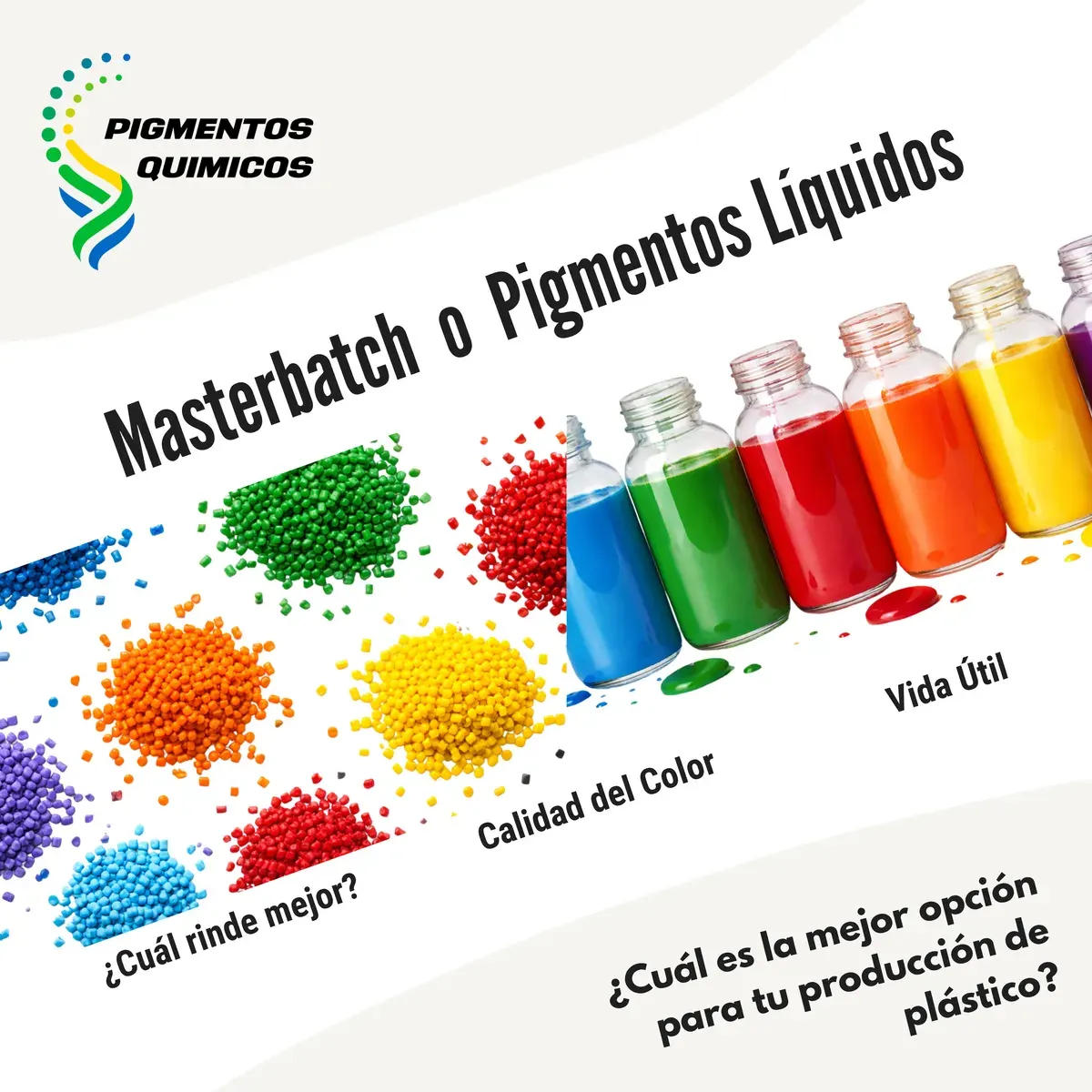
Masterbatch vs. Liquid Pigments: Analysis of Operational Efficiency and Color Stability
For process engineers facing the challenge of maintaining consistency in high-speed production lines, this analysis breaks down the gap between theoretical pigment selection and real-world rheological behavior.
For color experts, process engineers, and polymer specialists facing the challenge of maintaining consistency in high-speed production lines, this technical analysis breaks down the gap between theoretical pigment selection and its rheological behavior on the production floor.
Although the design manual suggests a linear and predictable dosage, the technical reality in the extrusion barrel reveals that the choice of color vehicle alters melt viscosity, thermal kinetics, and ultimately the optical integrity of the final part.
Molecular Interaction and Matrix Compatibility
The efficiency of a Masterbatch lies in the affinity of its carrier resin (carrier) with the base polymer. If the Melt Flow Index (MFI) of the carrier is significantly lower than that of the matrix, dispersion problems and pigment concentration points are generated.
In contrast, Liquid Pigments use chemical vehicles that, while facilitating rapid distribution, can act as plasticizing agents. This can reduce impact resistance or the heat deflection temperature if the molecular interaction with the resin additives is not rigorously monitored.
Thermal Kinetics and Pigment Degradation
Using Masterbatch subjects the pigment to a 'double thermal history': first during its manufacture and then during final processing. This accumulated stress can induce thermochromism phenomena in sensitive organic pigments.
Liquid systems mitigate this risk by omitting the first heat cycle, but introduce a critical variable: the stability of their vapor pressure. If the liquid vehicle volatilizes prematurely, micro-voids are generated in the structure, affecting reflectance and causing chromatic deviations detectable in the visible spectrum.
Optical Phenomena and Particle Dispersion
Chromatic stability is not just saturation — it is homogeneity. A poorly dispersed pigment creates agglomerates that act as erratic light dispersion centers.
In thin-wall injection processes, the surface tension of liquid systems must be perfectly balanced with the polymer matrix to avoid color migration to the surface, which would alter the ΔE measurement in final quality control.
Optimize your profitability beyond cost-per-kilo. At Pigmentos Químicos, we refine your Let Down Ratio (LDR) with the technical precision your process demands.