Pigmentos Químicos
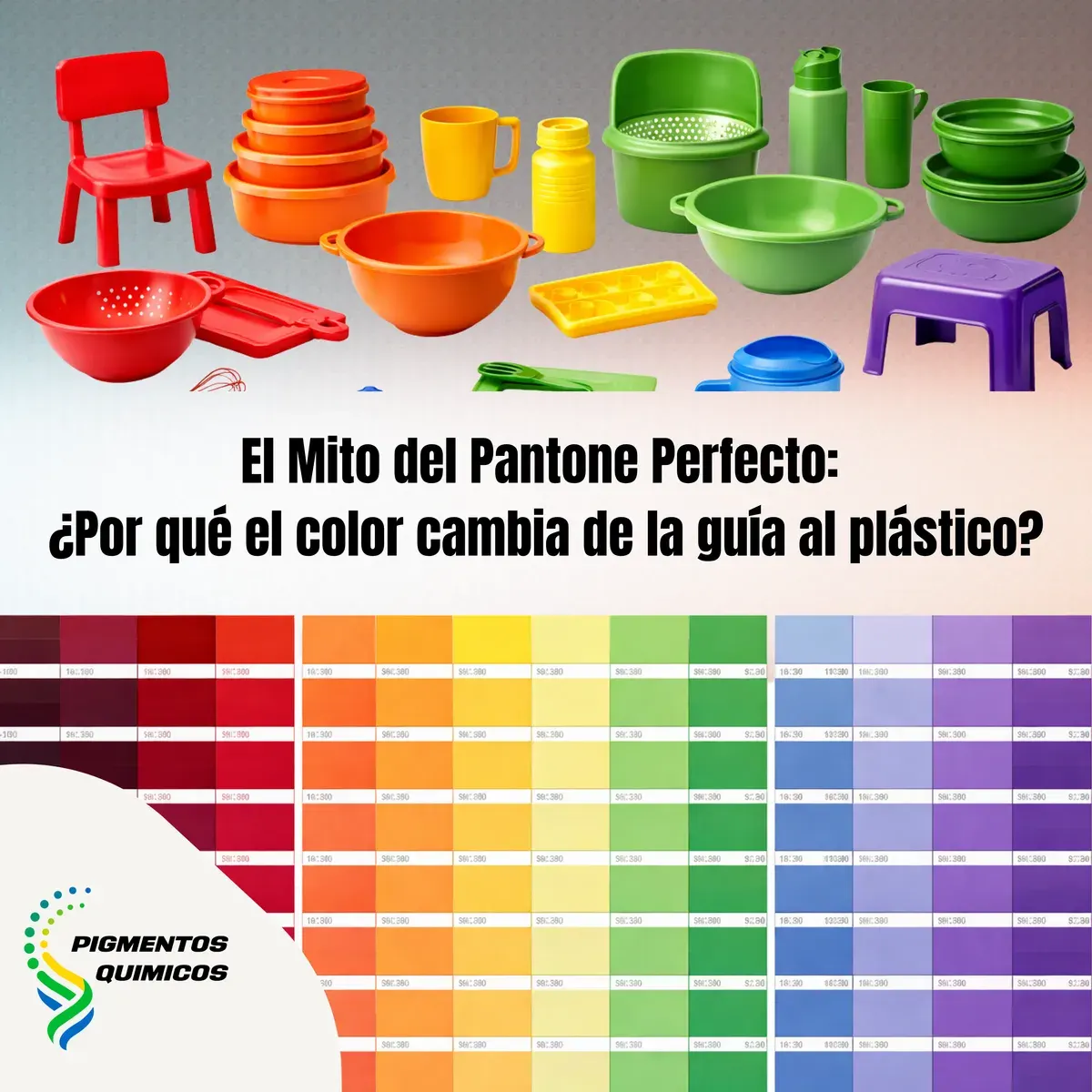
El Mito del Pantone Perfecto: ¿Por qué el color cambia de la guía al plástico?
Technical· 2 min read

The Perfect Pantone Myth: Why Does Color Change from Guide to Plastic?

For designers and plastics processors, the Pantone® guide is the visual standard. However, translating a code from paper to a polymer part is not copy-and-paste — it is a challenge in applied colorimetry.

For designers and plastics processors, the Pantone® guide is the visual standard. However, in pigment engineering, translating a code from a paper guide to a polymer part is not a 'copy-and-paste' process — it is a challenge in applied colorimetry.

Why do chromatic discrepancies exist?

The Nature of the Substrate: Ink vs. Mass

The main difference lies in the physics of the substrate. Pantone® guides are printed with offset inks on coated paper.

Reflection vs. Transmission: On paper, light bounces off a flat surface. In plastic, light interacts with the polymer matrix, penetrating the part.
Refractive Index: Each resin (PP, PE, ABS, PET) has a different refractive index that alters how we perceive the pigment. The same pigment will look drastically different in crystal polystyrene than in talc-filled polypropylene.

Thermal Stability and Degradation

Unlike printing inks that dry at room temperature or with UV, pigments for plastics must withstand melt processes ranging between 180°C and 300°C.

Thermochromism: Many organic pigments undergo structural changes under residual heat, causing shifts toward more yellowish or grayish tones.
Residence Time: Excessive material time inside the injection barrel can degrade the additive package, moving the final color away from the original sample.

The Phenomenon of Metamerism

This is the most common technical error: a color that matches perfectly under office light, but fails under sunlight or on the shelf.

Since the chemical formulations of Pantone inks and Masterbatches are completely different, their spectral reflectance curves do not coincide. At Pigmentos Químicos we evaluate samples under standard illuminants (D65, TL84, A) to ensure that ΔE (color deviation) remains within the allowed tolerance ranges.

Interaction with Additives and Fillers

The final color depends not just on the pigment, but on the 'invisible chemistry' of the part:

Mineral Fillers: The use of calcium carbonate or glass fiber increases opacity but 'muddies' the purity of the color, reducing saturation.
Recycled material: The use of post-consumer resin (PCR) introduces a variable chromatic base (generally grayish or yellowish) that acts as a filter, making it impossible to achieve fluorescent or very light Pantone tones.

How to Achieve Technical Precision?

To reduce the gap between the guide and reality, it is necessary to stop relying on the human eye and use precision tools:


CIELAB coordinates: Define color using the axes L* (lightness), a* (green-red), and b* (blue-yellow).
ΔE tolerances: Contractually establish what deviation is acceptable (typically ΔE < 1.0 for critical applications).
Color plate (Match-Plate): Final approval must always be made on an injected plate with the actual project resin, never on the paper guide.

Ready for the ideal color?

Let's talk. We'll send you a proposal as soon as possible.

WhatsApp us
ISO 9001:2015 Certified

Certification
ISO 9001:2015

Audited and validated processes under international quality standards. Every batch traceable, every color repeatable.

30 Years Anniversary

30 years
making color

30 years specializing in masterbatch, pigments, and high-quality additives for injection, extrusion, and blow molding.

Authorized PANTONE Partner

Authorized
Partner

Color matching referenced to the Pantone system.