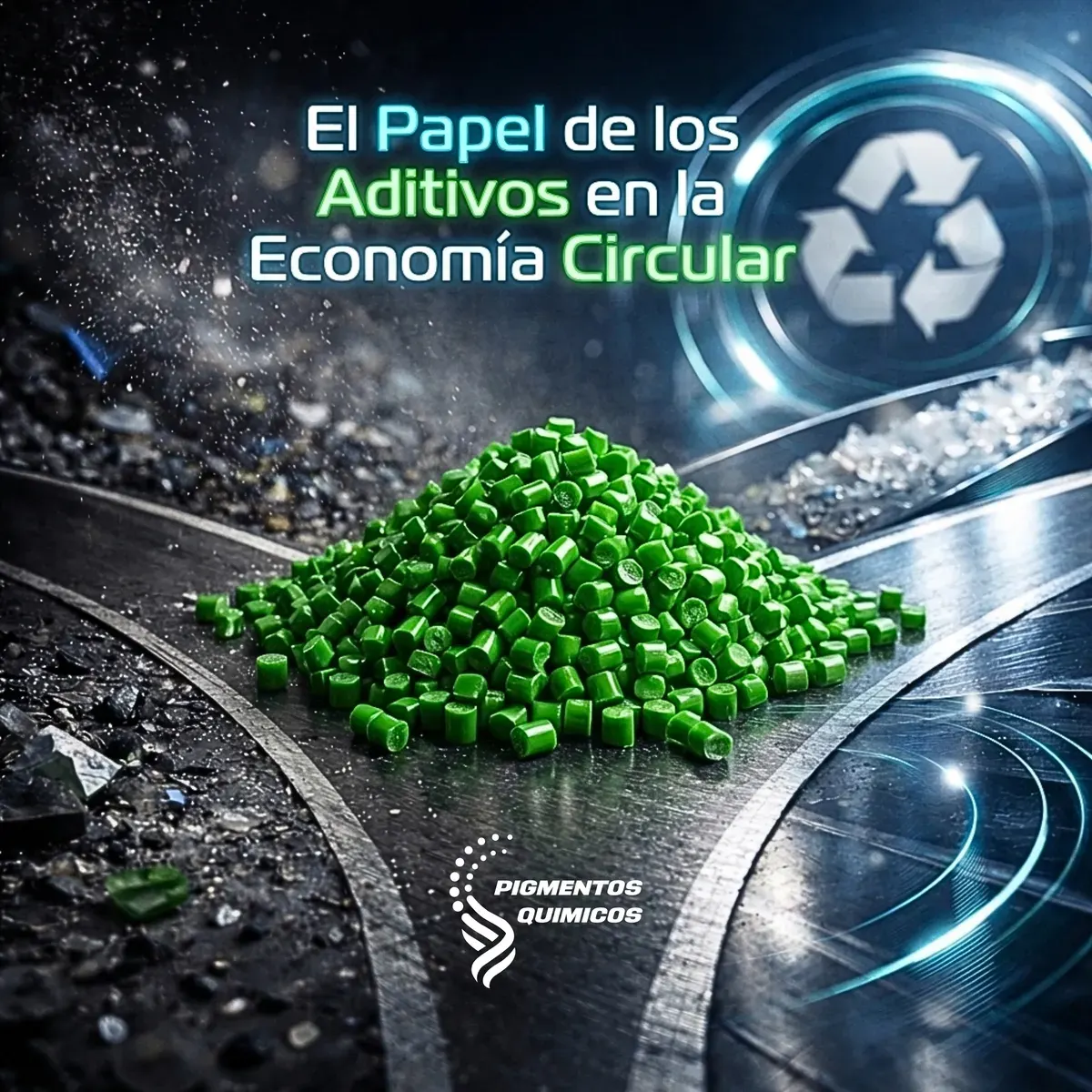
Sustainability and Plastics: The Strategic Role of Additives in the Circular Economy
How innovation in smart additives and digital traceability is redefining the rules.
Sustainability and Plastics: The Strategic Role of Additives in the Circular Economy
The plastics industry is at a decisive moment. With global production that has multiplied exponentially in recent decades and projections anticipating its doubling by 2050, the transition toward circular models has ceased to be an option and has become an imperative. At the center of this transformation are plastic additives: components that, depending on how they are designed and used, can be the greatest obstacle or the most powerful catalyst for circularity.
This article analyzes how innovation in additives is redefining the rules of the game for manufacturers, formulators, and R&D professionals seeking to align technical performance with environmental responsibility.
Why are additives key in the circular equation?
Additives represent a fundamental paradox in the plastics industry. On one hand, they are indispensable: they provide flexibility, UV resistance, fire retardancy, and barrier properties that make critical applications possible in sectors such as food, automotive, and healthcare. On the other hand, many of these compounds complicate or directly prevent mechanical recycling, contaminate recovered material streams, and can release harmful substances into the environment.
More than 13,000 additives and monomers used in plastics manufacturing have been identified. Of these, approximately 7,000 have been evaluated for hazardous properties, and around 3,200 have been classified as potentially harmful. This reveals a significant knowledge gap that the industry must address urgently.
Key fact: Only 10% of plastic waste is recycled globally. Around 25% ends up in the environment, and additives not chemically bonded to the base polymer leach into ecosystems, generating health and biodiversity risks.
Technical challenges: when additives slow circularity
Mechanical recycling, which remains the most widely used process for plastic recovery, faces significant limitations arising from the presence of certain additives:
Five areas of innovation transforming the landscape
Despite the challenges, innovation in additives offers extraordinary opportunities to drive circularity. The main lines of development include:
Regulatory push: from voluntary to mandatory
The global regulatory framework is accelerating the transition. The European Union, through the Packaging and Packaging Waste Regulation (PPWR), has moved from guidelines to codified law, establishing strict minimum recycled content requirements and prohibiting specific packaging formats. The United Kingdom has implemented an Extended Producer Responsibility (EPR) framework where fees scale with product complexity: the harder to recycle, the higher the cost.
In Spain, the PERTE for the Circular Economy has recently approved 115 projects with funding exceeding 150 million euros to boost circularity in the plastics sector, mobilizing total investment of up to 473 million between public and private funds. These calls specifically seek to reduce the presence of additives with polluting substances and promote eco-design.
Conclusion: additives as a strategic lever
The relationship between additives and circularity is not a binary matter. It is not about eliminating additives, but about redesigning their function within a circular system. Companies that invest in simplified formulations, safe alternatives, and traceability technologies will be better positioned not only to comply with emerging regulations, but to capture value in a market that increasingly rewards verifiable sustainability.
Plastic has a place in the circular economy, as long as the industry accepts the challenge of transforming its additives from barriers into facilitators of change.
What role do additives play in the circular economy of plastic?
Additives are essential components that improve the properties of plastic, but can hinder its recycling. Current innovation focuses on developing bio-based, smart, and traceable additives that facilitate material recovery and reuse, transforming additives from obstacles into enablers of circularity.